In our last post, we explained why full depth-of-focus (DoF) stacking — built on pixel fusion plus global smoothing — traps gold-wire-bonding 100% inspection in a triple bind: escaped defects, false calls, and throughput shortfalls. Resolving this contradiction means rethinking the imaging foundation itself.
This is exactly the problem Phasora3D solved with its patented multi-layer focus tracking (displacement imaging) technology — the architecture underpinning the entire PSR2000 series imaging modules.
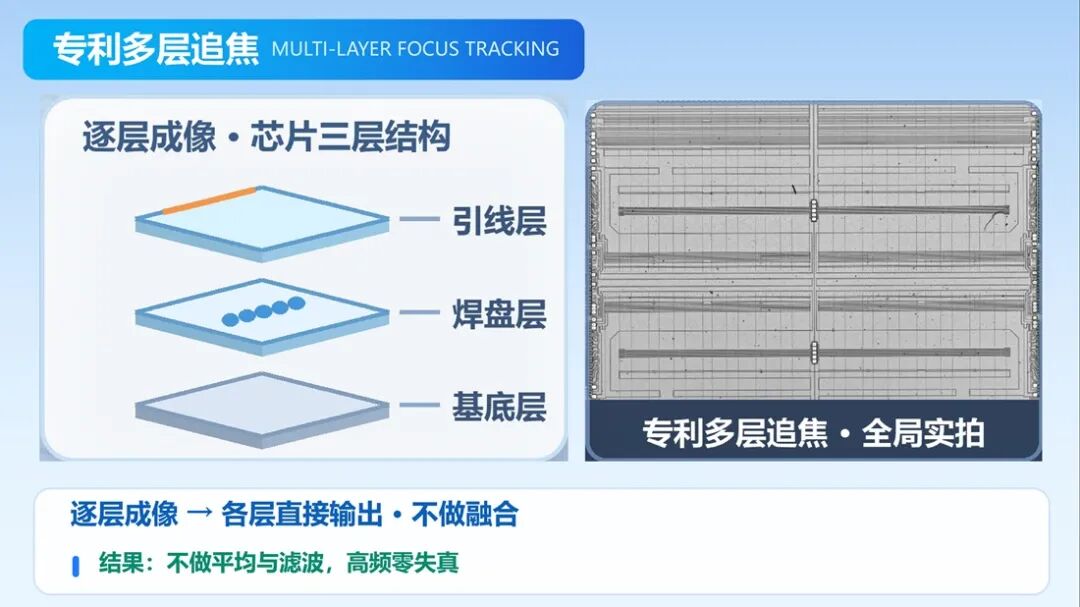
The core idea: image layer by layer. Output layer by layer.
No cross-layer pixel fusion. No global smoothing filter.
Following the chip’s true physical structure, the system splits the device into three layers — substrate layer, pad layer, and wire layer — and captures raw images on each focal plane, preserving every layer’s original pixels in full.
This design suppresses the salt-and-pepper noise caused by highly reflective gold wires — without erasing faint defects such as micro-scratches and subtle wire deformation. The classic DoF dilemma (“smooth noise → kill defects; keep detail → flood false calls”) is gone.
Performance built for the line
Multi-layer focus tracking needs no massive multi-layer pixel fusion:
- Algorithm response: < 10 ms
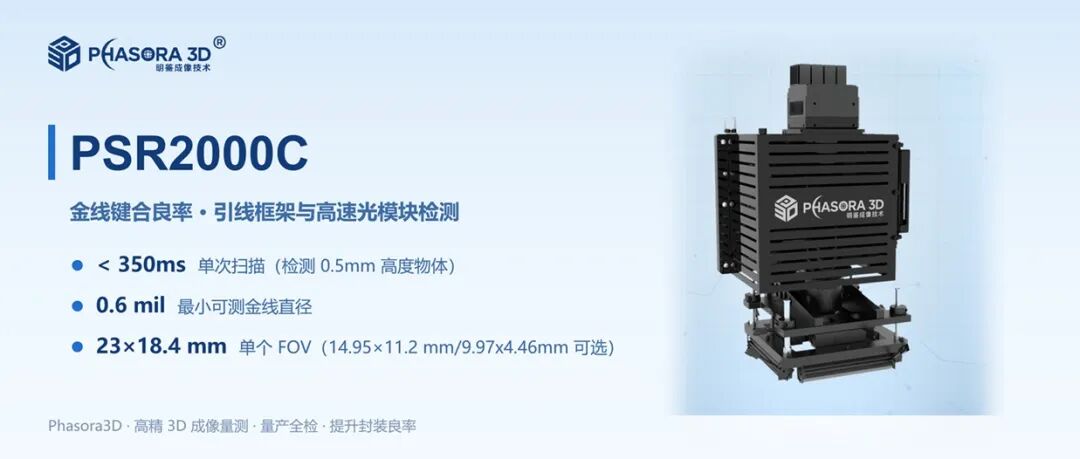
- On the PSR2000C module, scan speed reaches 350 ms/FOV
- Layered raw images are output directly — far better suited to machine-vision AI classification — and fully match the inline 100%-inspection takt of lead-frame and high-speed optical-module lines.
Two architectures, two purposes
- DoF stacking: fuses layers into one composite image — built for human eye, for sample observation.
- Patented multi-layer focus tracking: preserves raw layered data — built for machines, for defect detection.
The takeaway
The architectural fix solves both defect loss and processing speed. But gold-wire-bonding inspection demands more than 3D height measurement: it must also catch a wide range of 2D surface defects — scratches, contamination, and bond-surface deformation.
In Part 3, we’ll show how Phasora3D leverages the PSR2000 series’ unified 2D + 3D multi-dimensional data capability on real OSAT production lines.