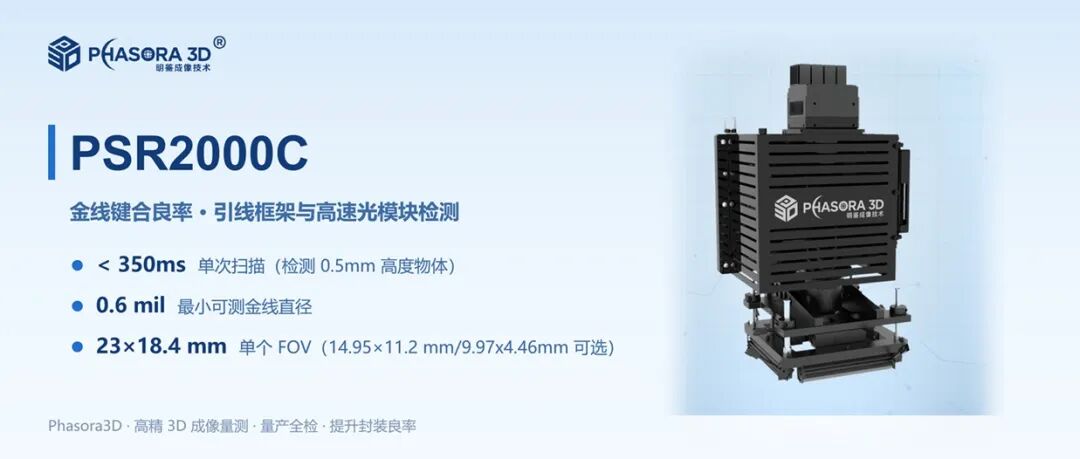
Advanced packaging has entered the era of high-density fine wires and chiplet stacking. At 0.6 mil, ultra-fine gold wire bonding is now standard — and so are the micrometer-scale defects that come with it: broken wires, wire sag and sweep, bond misalignment, and pad surface damage. Traditional 2D vision has hit its resolution ceiling, which is why 3D imaging has become essential for yield control at OSATs.
Yet many packaging fabs hit a wall when deploying 3D inline inspection. The industry’s default solution — full depth-of-focus (DoF) stacking — delivers three familiar problems in production: escaped defects, false calls, and throughput that fails to meet takt time. True 100% inline inspection stays out of reach. This is precisely the pain point Phasora3D has been addressing at the imaging-architecture level.
Why DoF stacking doesn’t work on the production line
The logic sounds simple: capture multiple focal planes, then algorithmically fuse them into one all-sharp image. It is excellent for lab sample observation and visual archiving — but it is not built for production defect detection.
The full pipeline is: multi-frame acquisition → pixel fusion → global smoothing.
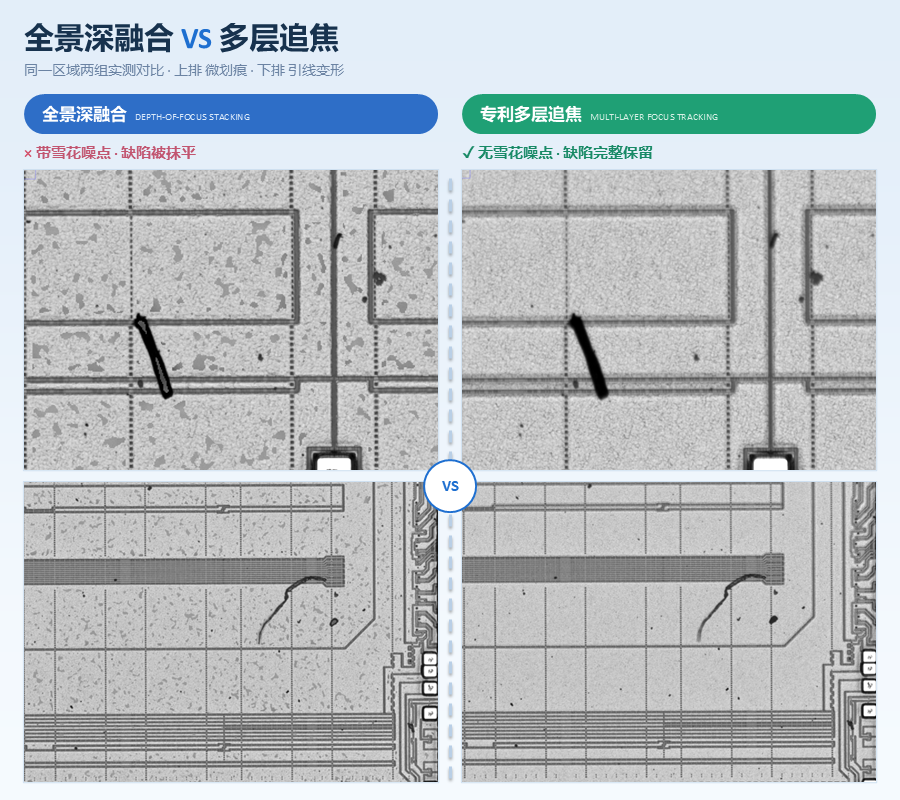
Gold wires and pads are highly reflective metals, so images come out noisy. To suppress salt-and-pepper noise, the algorithm must apply heavy smoothing — and the side effect is fatal: micrometer-scale micro-scratches and subtle wire deformation get wiped out as if they were noise.
This creates an unwinnable zero-sum trade-off:
- Smoothing turned up → micro-defects erased → escaped defects flow downstream, causing batch scrap.
- Smoothing turned down → snow noise floods in → a tidal wave of false calls, requiring massive manual re-inspection.
Worse, the compute cost does not fit the line. Multi-layer fusion plus post-processing takes 3–5 seconds per frame. On high-speed lines such as lead-frame and high-speed optical-module packaging, second-level processing is only fit for lab sampling — never for mass inline 100% inspection.
The core insight
DoF stacking chases “one synthetically perfect image to the human eye.” But the real job of production 100% inspection is to preserve every raw defect signal. The two goals are fundamentally at odds.
The takeaway
Many equipment selections judge imaging only by how clean the rendered picture looks — and miss that the underlying algorithm is destroying defect information. To solve this, a differentiated technical route has emerged: patented multi-layer focus tracking (displacement imaging).
In our next post, we break down how this technology escapes the inherent limits of DoF stacking — the very architecture powering the Phasora3D PSR2000 series imaging modules.